If you have ever replied “Get it” or “Got it” to someone, you may have wondered whether the two phrases mean the same thing.
They often appear in similar conversations, but they are not always interchangeable.
The confusion comes from the verb get, which changes form depending on tense and meaning.
Get it and got it can both communicate understanding, but they can also express possession, successful completion, or an ability to do something.
The good news is that the difference is easier than it first appears.
Quick Answer
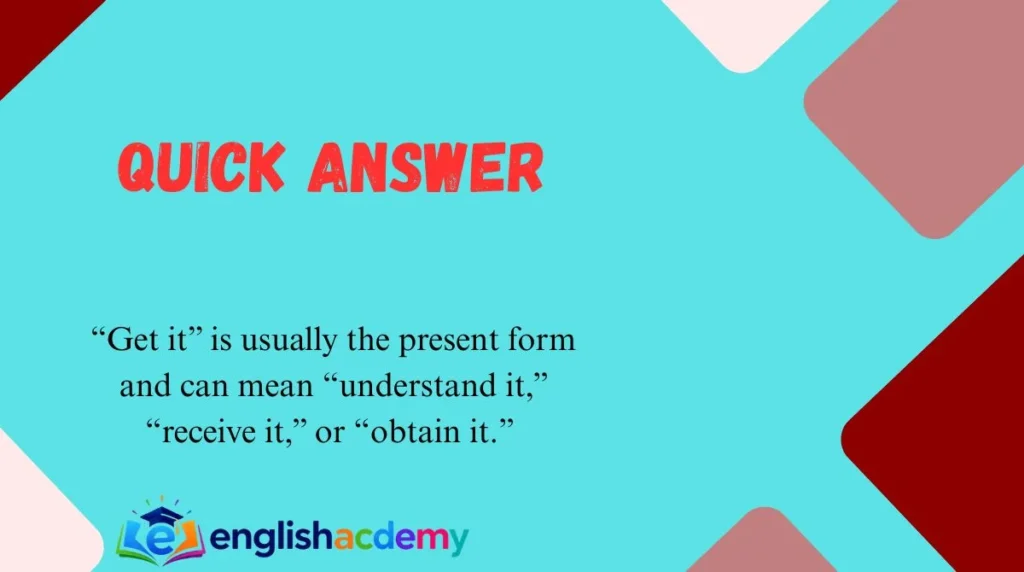
“Get it” is usually the present form and can mean “understand it,” “receive it,” or “obtain it.” “Got it” is usually the past form, but in everyday conversation it is also commonly used as a fixed expression meaning “I understand” or “I understand your instructions.”
For example:
- Do you get it? = Do you understand?
- I get it. = I understand.
- Did you get it? = Did you receive or understand it?
- Got it. = I understand / I will do what you said.
The important point is that “got it” does not always describe a past event when it is used as a conversational response.
Get It vs Got It at a Glance
| Point | Get it | Got it |
|---|---|---|
| Basic form | Get + it | Got + it |
| Verb form | Present form of get | Past form of get |
| Common meaning | Understand, obtain, receive | Understood, received, obtained |
| Conversational meaning | I understand | I understand |
| Typical question | Do you get it? | Did you get it? |
| Common reply | I get it. | Got it. |
| Tone | Neutral and conversational | Direct and conversational |
| Formality | Informal to neutral | Informal to neutral |
| Can mean “understand”? | Yes | Yes |
| Can mean “receive”? | Yes | Yes |
| Can mean possession? | Yes, depending on structure | Yes, depending on structure |
| Can refer to the past? | Usually not by itself | Yes |
| Can refer to the present? | Yes | Sometimes, especially in fixed conversational use |
| Best use | Present understanding or obtaining something | Past events or acknowledging instructions |
| Common mistake | Treating it as a universal substitute for “got it” | Assuming it always refers to the past |
What Does “Get It” Mean?
Get it has several meanings in English. Its exact meaning depends on the context.
The most common meanings are:
- Get It vs Got It
- Receive something
- Obtain something
- Get It vs Got It
- Be able to understand a joke, idea, or reference
In everyday conversation, get it often means understand it.
“Get It” Meaning “Understand”
Consider this conversation:
“The answer is based on the second rule.”
“Oh, I get it now.”
Here, get it means understand it.
The speaker is saying that the idea has become clear.
You can also say:
- Get It vs Got It
- I don’t get it.
- Do you get it?
- Get It vs Got It
- I think I get it.
- Get It vs Got It
These are extremely common expressions in spoken English.
“I Get It”
I get it usually means I understand.
For example:
“You want me to send the report before noon.”
“Yes, I get it.”
It can also express emotional understanding:
“I get it. You’re tired after working all day.”
Here, the speaker means something closer to “I understand how you feel.”
This use is especially common in informal conversation.
“I Don’t Get It”
I don’t get it means I don’t understand.
For example:
“Why did everyone laugh?”
“I don’t get it.”
This can refer to:
- Get It vs Got It
- an explanation
- Get It vs Got It
- a situation
- a reference
- Get It vs Got It
“Do You Get It?”
Do you get it? asks whether someone understands.
For example:
“The first step comes before the second step. Do you get it?”
However, tone matters.
Depending on how it is said, “Do you get it?” can sound impatient, especially if the speaker expects the other person to understand already.
A softer alternative is:
“Does that make sense?”
or:
“Do you understand?”
What Does “Got It” Mean?
Got it has an important special feature.
Grammatically, got is the past form of get. But in everyday English, “Got it” is also widely used as a short conversational response meaning:
“I understand.”
That meaning does not necessarily refer to something that happened in the past.
“Got It” as “I Understand”
Imagine a manager giving an employee an instruction:
“Please send the final version to the client before 4 p.m.”
“Got it.”
The employee is not saying that they understood something yesterday.
They are acknowledging the instruction right now.
In this context, got it means:
- Get It vs Got It
- I understand what you mean.
- I understand what you want me to do.
- Get It vs Got It
This is one of the most common uses of got it in modern conversation.
Why Does “Got It” Mean “I Understand”?
The expression developed from the idea of receiving or grasping information.
When someone says “Got it,” the implied meaning is something like:
“I have received the information.”
From there, the expression naturally developed into an acknowledgment meaning:
“I understand.”
This is why got it can function as a complete conversational response.
You do not need to say:
“I have got it.”
Simply saying:
“Got it.”
is perfectly natural in informal conversation.
Get It vs Got It for Understanding
This is where most people encounter the difference.
Compare these sentences:
I get it.
Got it.
Both can mean “I understand,” but they do not feel exactly the same.
I get it describes your understanding.
Got it usually acknowledges information, an explanation, or an instruction.
Example
“The meeting has moved to Friday.”
“Got it.”
This sounds natural because the second speaker is acknowledging new information.
Now consider:
“Why did you leave early?”
“I get it now.”
Here, I get it now emphasizes the moment of understanding.
The phrases overlap, but their conversational functions differ.
Get It vs Got It in Questions
Questions make the grammatical difference especially clear.
Do You Get It?
Do you get it? normally asks:
Do you understand it?
Example:
“I’ve explained the process twice. Do you get it now?”
The verb get is present because the question uses the present auxiliary do.
Did You Get It?
Did you get it? normally asks about a past event.
It can mean:
- Get It vs Got It
- Did you obtain it?
- Get It vs Got It
- Did you hear it?
- Get It vs Got It
The context determines the meaning.
For example:
“I sent you the file yesterday. Did you get it?”
Here, get it means receive it.
Another example:
“I explained the joke earlier. Did you get it?”
Here, get it means understand it.
Notice something important: after did, English uses get, not got.
Correct:
Did you get it?
Incorrect:
Did you got it?
This is one of the most common grammar mistakes involving these forms.
Why “Did You Got It?” Is Wrong
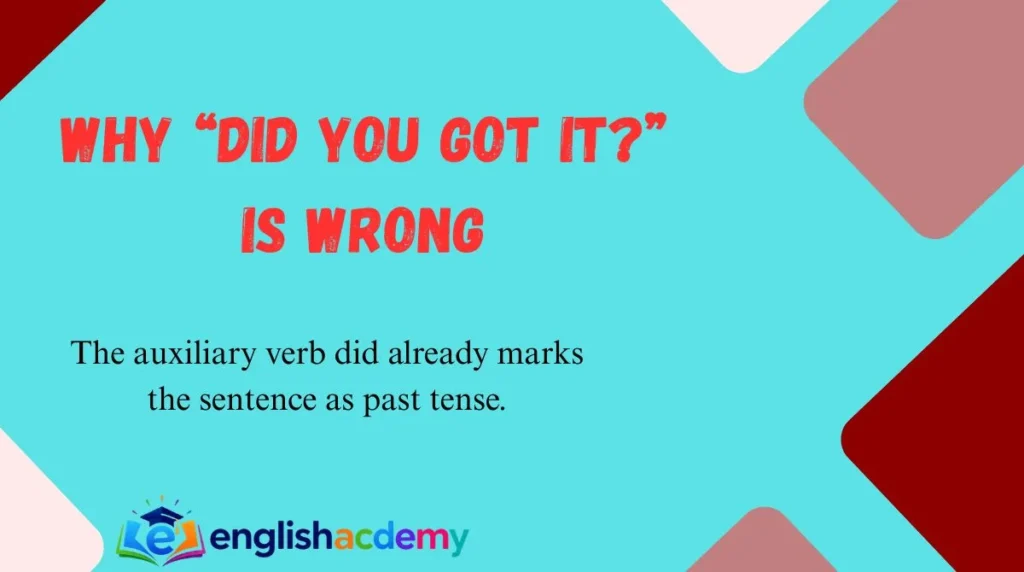
The auxiliary verb did already marks the sentence as past tense.
Therefore, the main verb returns to its base form:
Did + get
not:
Did + got
So:
- Did you get it? ✓
- Did you got it? ✗
The same rule applies to other verbs:
- Get It vs Got It
- Did she see it?
- Did they take the train?
- Get It vs Got It
Not:
- Get It vs Got It
- Did she saw it?
- Did they took the train?
- Get It vs Got It
The Grammar Behind “Get” and “Got”
The verb get is irregular.
Its basic forms include:
- Get It vs Got It
- gets — third-person singular present
- got — past form
- got/gotten — past participle, depending on variety and construction
Examples:
I get the idea.
She gets the idea.
I got the idea yesterday.
In perfect constructions, usage differs somewhat between American and British English.
American English commonly uses:
I have gotten better at it.
British English generally prefers:
I have got better at it.
But this distinction is separate from the everyday conversational phrase “Got it.”
“Get It” as a Present-Tense Expression
When get it means understanding, it can describe a current state of comprehension.
Examples:
I get it now.
I don’t get it.
She gets it.
They finally get it.
The phrase can also appear after modal verbs:
You should get it now.
He might get it after another explanation.
You’ll get it eventually.
Here, get remains in its base form because of the modal verb.
“Got It” as a Past-Tense Expression
In its ordinary grammatical sense, got it can describe something that happened in the past.
For example:
I got it yesterday.
She got it from the store.
We got it from the teacher.
In these sentences, got genuinely functions as a past-tense verb.
The meaning depends on the context.
Receiving Something
“Did you get my email?”
“Yes, I got it this morning.”
Here, got it means received it.
Obtaining Something
“Where did you get that book?”
“I got it from the library.”
Here, got it means obtained it.
Understanding Something
“Did you understand the explanation?”
“Yes, I got it.”
Here, got it means understood it.
The same two words can therefore carry different meanings.
Get It vs Got It in Everyday Conversation
In casual spoken English, both expressions are extremely useful.
However, they often appear in different conversational roles.
Get it frequently describes understanding:
“I don’t get it.”
“I get it now.”
Got it frequently acknowledges something:
“Send this version instead.”
“Got it.”
That distinction is not an absolute grammar rule, but it is a very useful usage pattern.
When “Get It” Sounds More Natural
Use get it when you are talking about understanding as a present state.
Example 1
“I finally get it.”
This means the idea is clear to you now.
Example 2
“I don’t get it.”
You are saying that you currently do not understand.
Example 3
“Do you get it?”
You are asking whether someone understands.
Example 4
“Once you see the pattern, you’ll get it.”
This refers to understanding in the future.
When “Got It” Sounds More Natural
Use got it when acknowledging an instruction, correction, request, or piece of information.
Example 1
“Please wait outside.”
“Got it.”
Example 2
“Use the new password.”
“Got it.”
Example 3
“Don’t forget to attach the file.”
“Got it.”
In each case, got it works like a short acknowledgment.
Is “Get It” Correct?
Yes.
Get it is completely correct English.
It is especially natural when get means understand, receive, obtain, or grasp an idea.
Examples:
I get it.
Do you get it?
I don’t get it.
You’ll get it soon.
I get what you’re saying.
There is nothing grammatically wrong with the phrase.
The only question is whether get it fits the particular context.
Is “Got It” Correct?
Yes.
Got it is also correct.
It can be:
- Get It vs Got It
- A shortened conversational acknowledgment meaning “I understand.”
For example:
“Did you receive the document?”
“Yes, I got it.”
Here it refers to receiving something.
But:
“Please submit the document by Friday.”
“Got it.”
Here it is an acknowledgment.
Both uses are standard in everyday English.
Get It vs Got It: The Simplest Rule
A useful rule is:
Use “get it” when you are talking about understanding, receiving, or obtaining something in the present or in a general sense. Use “got it” for past events or as a conversational acknowledgment.
This is not a rule that covers every possible sentence, but it works extremely well in ordinary conversation.
Get It vs Got It in Professional Communication
The two expressions are common in workplaces, but your choice should depend on the tone you want.
“Got It” in Workplace Conversations
Got it is natural in quick workplace exchanges.
For example:
“Please update the spreadsheet before the meeting.”
“Got it.”
It is concise and clear.
However, in a highly formal email, a complete sentence may sound more polished.
Instead of:
Got it.
you might write:
Understood.
or:
Understood. I’ll update the spreadsheet before the meeting.
This is not because got it is grammatically wrong. It is simply a matter of register and context.
“Get It” in Professional Writing
Get it is also acceptable in professional communication when the meaning is appropriate.
For example:
“I get it now. The problem was caused by the incorrect data.”
That sentence is natural and conversational.
In a formal report, however, you might choose:
I understand now that the problem was caused by incorrect data.
The difference is primarily about style, not correctness.
Is “Got It” Formal or Informal?
Got it is generally informal to neutral.
It is very common in:
- Get It vs Got It
- instant messages
- Get It vs Got It
- text messages
- quick emails
- customer service conversations
- Get It vs Got It
It is less suitable when you need a highly formal or carefully worded response.
For formal writing, alternatives include:
- Get It vs Got It
- I understand.
- I acknowledge your instructions.
- Thank you for clarifying.
- Get It vs Got It
The best choice depends on the relationship and situation.
Is “I Get It” Formal or Informal?
I get it is also mainly conversational.
It is perfectly natural in everyday speech:
“I get it. You need more time.”
But in formal academic or business writing, I understand is often a better choice.
Compare:
I get it now.
with:
I understand the reasoning now.
The second sounds more formal and precise.
Get It vs Got It in Emails
Informal Email
Got it. I’ll send the revised document this afternoon.
This is perfectly natural when writing to a colleague you communicate with casually.
More Professional Email
Understood. I’ll send the revised document this afternoon.
Friendly Professional Email
Thanks for clarifying. Got it—I’ll send the revised document this afternoon.
The third version keeps the natural conversational tone while adding a little more warmth.
Get It vs Got It in Text Messages
Texting strongly favors short expressions.
For example:
“Meet me at 8 instead.”
“Got it.”
That is completely natural.
You could also write:
“I get it now 😂”
if you have just understood something.
The two expressions therefore serve different purposes even in very short messages.
Get It vs Got It in School
Students often use both phrases when discussing explanations.
Understanding an Explanation
“I get it now.”
This means the lesson has become clear.
Acknowledging an Instruction
“Got it.”
A teacher might say:
“Remember to show your working.”
A student could reply:
“Got it.”
Asking About Understanding
“Do you get it?”
A teacher might instead say:
“Does everyone understand?”
The second question is often more neutral and appropriate in a classroom setting.
Get It vs Got It in Business
Business conversations often use got it as a quick acknowledgment.
For example:
“I’ll handle the client call. You prepare the presentation.”
“Got it.”
This tells the other person that the instruction was received and understood.
However, if the situation requires a written record, a fuller response is usually better:
“Understood. I’ll prepare the presentation and have it ready before the client call.”
This removes ambiguity.
Get It vs Got It in Customer Service
Customer service representatives may use got it in informal chat, but a more professional response can be preferable.
Instead of:
Got it. I’ll check that.
you might use:
Understood. I’ll check that for you.
The choice depends on the company’s tone and communication standards.
Get It vs Got It in Academic Writing
Neither phrase is usually the best choice for formal academic prose when the intended meaning is understand.
Instead of:
Researchers finally got it.
a formal academic sentence might say:
Researchers finally understood the relationship.
That said, get can appear in academic writing when it is part of an established expression or when the style is intentionally conversational.
The issue is not correctness. It is register.
Get It vs Got It in American and British English
Both get it and got it are used in both American and British English.
There is no major US-versus-UK rule that says one is correct and the other is incorrect.
For example, both varieties naturally use:
I get it.
Got it.
Did you get it?
I got it yesterday.
The main differences involving get/got/gotten appear in certain perfect constructions rather than in the basic phrases get it and got it.
American English
American English commonly uses gotten as a past participle in some contexts:
I’ve gotten better at understanding it.
British English
British English commonly uses got:
I’ve got better at understanding it.
But this does not change the ordinary conversational distinction between get it and got it.
The Different Meanings of “Get It”
One reason get it can be confusing is that get is an extremely flexible verb.
Get It = Understand It
I don’t get it.
Get It = Receive It
Did you get it in the mail?
Get It = Obtain It
I’ll get it from the store.
Get It = Catch It
The goalkeeper got it.
Get It = Notice or Realize It
I didn’t get it at first, but now I see what happened.
Context tells you which meaning is intended.
The Different Meanings of “Got It”
Got it can also carry several meanings.
Got It = Understood
“The deadline is Monday.”
“Got it.”
Got It = Received
“Did the package arrive?”
“Yes, I got it.”
Got It = Obtained
“Where did you get the ticket?”
“I got it online.”
Got It = Successfully Caught
“Did you catch the ball?”
“Yeah, I got it.”
The surrounding words make the meaning clear.
Get It vs Got It and Context
Context is the key to choosing between these expressions.
Compare:
I get it.
This commonly means:
Get It vs Got It
Now:
I got it.
This can mean:
I understood it.
or:
I received it.
or:
I obtained it.
or, in a conversational exchange:
I understand your instruction.
The surrounding situation determines the meaning.
“I Got It” vs “Got It”
There is a small but useful difference in tone.
“Got It”
“Please call Sarah tomorrow.”
“Got it.”
This is short and direct.
“I Got It”
“Did you receive the report?”
“Yes, I got it.”
Here, I got it usually refers to an actual event.
However, I got it can also mean:
I understand.
For example:
“You don’t need to explain again. I got it.”
In that sentence, it is closer to “I understand.”
“I Get It” vs “I Got It”
These are especially easy to confuse.
I Get It
Usually means:
I understand.
It emphasizes present understanding.
“I get it now.”
I Got It
Can mean:
I understood.
or:
I received/obtained it.
or:
I understand your instruction.
“Okay, I got it.”
The difference is therefore partly grammatical and partly conversational.
Can “Get It” Mean “Understand”?
Yes.
This is one of its most common meanings.
Examples:
I get it.
Do you get it?
She doesn’t get it.
We finally get it.
You’ll get it soon.
The expression is natural and widely understood.
Can “Got It” Mean “Understand”?
Yes.
In everyday conversation, got it very commonly means “I understand.”
For example:
“Turn left after the bridge.”
“Got it.”
The speaker is not reporting a completed past event. They are acknowledging the information.
This is why translating got it mechanically as “I got it in the past” can produce the wrong interpretation.
Can You Say “Get It” as a Reply?
Yes, but it usually needs a slightly different structure.
If someone gives you an instruction:
“Send this to the manager.”
Replying:
“I get it.”
is grammatically possible, but it may sound like you are emphasizing that you understand the idea rather than simply acknowledging the instruction.
A more natural response is:
Got it.
or:
I understand.
This is one reason native speakers often prefer got it in quick exchanges.
Can You Say “Got It” Instead of “I Understand”?
Yes.
In informal conversation, got it is often a natural substitute for I understand.
For example:
“Don’t open that file.”
“Got it.”
This is equivalent to:
“Understood.”
or:
“I understand.”
But the tone is more conversational.
Can You Say “I Get It” Instead of “I Understand”?
Yes.
I get it is a common informal equivalent of I understand.
For example:
“I get it. You don’t want to discuss the issue right now.”
This sounds natural in conversation.
In formal writing, I understand is usually safer.
Common Collocations With “Get It”
Here are useful combinations:
- Get It vs Got It
- get it right
- Get It vs Got It
- get it clearly
- get it immediately
- Get It vs Got It
- get the point
- Get It vs Got It
- get the message
- Get It vs Got It
Examples:
I finally get it now.
I don’t get the joke.
Did you get the point?
I think I get what you mean.
Common Collocations With “Got It”
Common conversational patterns include:
- Get It vs Got It
- got it now
- got it right
- Get It vs Got It
- I got it
- yeah, got it
- okay, got it
- Get It vs Got It
Examples:
Okay, got it.
I got it right this time.
I got it wrong earlier.
Yeah, I got it.
20+ Real-Life Examples
Everyday Conversation
- Get It vs Got It
- “I don’t get it. Why did he leave?”
- “Oh, I get it now.”
- Get It vs Got It
- “I got it. You want me to wait here.”
Text Messages
- “Meet me outside the station.” — “Got it.”
- Get It vs Got It
- “Got it. See you at eight.”
- “Did you get it?”
- Get It vs Got It
Workplace Communication
- “Please send the invoice today.” — “Got it.”
- “I get it now. The numbers were entered incorrectly.”
- Get It vs Got It
- “Yes, I got it this morning.”
- “Got it. I’ll update the presentation.”
Business Communication
- “The client wants the meeting moved to Thursday.” — “Got it.”
- “I get what you’re saying, but we need more evidence.”
- “Did you get the contract?”
- “Yes, I got it from the legal team.”
- “Got it. We’ll use the revised figures.”
School and Learning
- “I get it now. We need to multiply before adding.”
- “Do you get it, or should I explain it again?”
- “Got it. I’ll submit the assignment tomorrow.”
- “I didn’t get the question at first.”
- “I finally got it after seeing the example.”
Professional Writing
- “Understood. I’ll make the requested changes.”
- “I understand the concern and will address it.”
- “I got it. I’ll review the document today.”
The final three examples show how a more formal context may favor understood or I understand over got it.
Common Mistakes With Get It and Got It
Mistake 1: “Did You Got It?”
Wrong:
Did you got it?
Correct:
Did you get it?
Why?
The auxiliary did already carries the past tense, so the main verb must use its base form.
Mistake 2: “Do You Got It?”
Wrong:
Do you got it?
Correct:
Do you get it?
Again, do requires the base form get.
Mistake 3: Thinking “Got It” Always Means Past
This is not always true in conversation.
“Please send me the file.”
“Got it.”
Here, got it means “I understand” or “I acknowledge your instruction.”
It does not necessarily mean that the speaker received the file in the past.
Mistake 4: Using “Got It” in Every Formal Situation
Got it is correct, but it can sound too casual in some professional or academic contexts.
Instead of:
Got it. Thank you.
you may prefer:
Understood. Thank you.
Mistake 5: Assuming “Get It” and “Got It” Are Always Interchangeable
They overlap, but they are not identical.
Compare:
I get it now.
with:
Got it.
The first emphasizes understanding.
The second often acknowledges information or an instruction.
Mistake 6: Confusing “I Got It” With “I Get It”
Consider:
I get it.
This normally expresses present understanding.
I got it.
This can express past understanding, possession, receipt, or acknowledgment.
The context matters.
Better Alternatives to Get It and Got It
Sometimes another expression is clearer.
Instead of “I Get It”
Use:
- I understand.
- I see.
- That makes sense now.
- I understand what you mean.
- I see your point.
Instead of “Got It”
Use:
- Understood.
- I understand.
- Thanks, that makes sense.
- I’ll take care of it.
- Thanks for clarifying.
Choose the alternative based on your desired tone.
Get It vs Got It: Formality Guide
| Situation | Natural Choice |
|---|---|
| Casual conversation | Got it |
| Text message | Got it |
| Friendly workplace chat | Got it |
| Quick instruction | Got it |
| Explaining new understanding | I get it |
| Asking about understanding | Do you get it? |
| Formal email | I understand / Understood |
| Academic writing | I understand / understand |
| Formal report | understand |
| Casual customer service | Got it |
| Formal customer service | Understood |
| Talking about receiving something | I got it |
| Talking about obtaining something | I got it |
Grammar: What Part of Speech Is “Get”?
Get is a verb.
It is one of the most versatile verbs in English.
Depending on context, it can mean:
- receive
- obtain
- become
- understand
- catch
- reach
- bring
- cause
- persuade
- experience
In get it, the word it is a pronoun functioning as the object of the verb.
I get it.
The same structure appears in:
I got it.
Is “It” a Noun?
No.
In get it and got it, it is a pronoun.
It normally refers to something already understood from context.
For example:
“Did you read the report?”
“Yes, I got it.”
Here, it refers to the report or perhaps the information in it.
Verb Tense
The basic distinction is:
get → present/base form
got → past form
Compare:
I get it.
I got it yesterday.
But conversational English creates an important exception in meaning:
Got it.
This is a conventional acknowledgment rather than a simple statement about a past event.
Do “Get It” and “Got It” Need an Article?
No.
You do not normally put a or an before it.
Correct:
I get it.
I got it.
Not:
I get a it.
I got an it.
The pronoun it already functions as the object.
Capitalization
Neither expression requires capitalization unless it begins a sentence.
Correct:
I get it.
Got it.
In a title, capitalization depends on the title style being used.
For example:
Get It vs Got It
Punctuation
As a complete conversational response, Got it can be followed by a period.
Got it.
In informal messaging, people often omit punctuation:
Got it
Both are understandable, but punctuation can affect tone in digital communication.
For professional writing, standard punctuation is usually preferable.
Is “Got It” Rude?
Not inherently.
Got it is normally neutral and efficient.
However, tone depends on context.
Compare:
“Got it, thanks!”
with:
“Got it.”
The first may sound warmer.
The second can sound abrupt in some situations, especially when the other person expects a more detailed response.
If you want to sound polite and professional, try:
Got it, thanks for clarifying.
or:
Understood. Thank you.
Is “I Get It” Rude?
It can be, depending on tone.
For example:
“Yes, I get it.”
can sound irritated if someone keeps explaining the same point.
Compare:
Oh, I get it now!
This sounds positive.
So the words themselves are not rude. Intonation, punctuation, context, and repetition can change the impression.
Is “Got It” Better Than “I Understand”?
Neither is universally better.
Use got it when you want to sound:
- brief
- conversational
- direct
- relaxed
Use I understand when you want to sound:
- more formal
- more explicit
- professional
- careful
For example:
“Please review the contract by Friday.”
“Got it.”
Casual and efficient.
“Please review the contract by Friday.”
“I understand. I’ll review it before then.”
More formal and complete.
Is “Get It” More Natural Than “Got It”?
Not generally.
The two expressions are natural in different situations.
I get it is especially natural when describing your current understanding.
Got it is especially natural when acknowledging instructions or information.
Trying to choose a universal winner misses the real distinction.
A Simple Decision Guide
Ask yourself what you are trying to say.
If you mean “I understand”
You can use:
I get it.
or:
I understand.
If you are acknowledging an instruction
Use:
Got it.
If you are asking whether someone understands
Use:
Do you get it?
or, more neutrally:
Do you understand?
If you are asking whether someone received something
Use:
Did you get it?
If you are saying that you received something in the past
Use:
I got it.
If you want a formal response
Use:
Understood.
or:
I understand.
Memory Tricks
Here are a few easy ways to remember the difference.
Trick 1: Get = Understanding Now
Think:
I get it = I understand it now.
Trick 2: Got = Acknowledged
Think:
Got it = Message received.
This is especially useful for instructions.
Trick 3: Do + Get
Remember:
Do you get it?
Never:
Do you got it?
Trick 4: Did + Get
Remember:
Did you get it?
Never:
Did you got it?
The words do and did already control the tense.
Trick 5: One-Line Rule
Get it describes understanding; got it often acknowledges understanding.
It is not a complete grammar rule, but it is an excellent conversational shortcut.
FAQs
Is “get it” or “got it” correct?
Both are correct. The right choice depends on meaning and context. Get it commonly describes present understanding, while got it can describe a past event or function as a conversational acknowledgment.
Does “got it” mean “I understand”?
Yes. In everyday English, got it very commonly means “I understand” or “I understand your instruction.”
Is “I get it” grammatically correct?
Yes. I get it is grammatically correct and commonly means “I understand it.”
Is “Did you got it?” correct English?
No. The correct sentence is:
Did you get it?
Because did already marks the past tense, the verb must remain in its base form.
Is “Do you got it?” correct?
No. Say:
Do you get it?
The auxiliary do takes the base form get.
Can “I got it” mean “I understand”?
Yes. In informal conversation, I got it can mean “I understand.”
For example:
“You need to click the button first.”
“Okay, I got it.”
Is “got it” formal?
Got it is generally conversational and informal to neutral. It is appropriate in many everyday and workplace situations, but understood or I understand may be better for highly formal communication.
Is “get it” American or British English?
Both get it and got it are used naturally in American and British English. They are not expressions belonging exclusively to one variety of English.
Are “get it” and “got it” interchangeable?
Not always. They can overlap when they refer to understanding, but get it often describes present understanding, while got it frequently works as an acknowledgment or refers to a past event.
Conclusion
Get it vs got it is not a battle between a correct phrase and an incorrect one. Both are correct, but they perform different jobs depending on context.
Use get it when you are talking about understanding something in the present or in a general sense:
I get it.
Do you get it?
I don’t get it.
Use got it when you are talking about something you received or obtained in the past:
I got it yesterday.
You can also use got it as a short conversational acknowledgment:
“Please send the report by noon.”
“Got it.”
That last use is especially important. In everyday English, got it often means “I understand”, even though got is technically the past form of get.
The Best Rule to Remember
Get it = I understand it / I understand it now.
Got it = I understood it, received it, obtained it, or—very commonly—I understand your instruction.
If you are writing formally, choose I understand or Understood when you want a more polished tone. If you are having a normal conversation, texting, or responding to a quick instruction, got it is completely natural.
The key is not to ask which phrase is universally correct. Ask what you mean, what tense you need, and how formal the situation is.
That is the real difference between get it vs got it.

I am Julian Brooks, an English language enthusiast and content writer at EnglishAcademy. I create clear grammar lessons, vocabulary guides, and writing tips to help learners improve their English with confidence every day.